
When is March on Washington?
| Date | Name | Day | Week | Days left |
|---|---|---|---|---|
| August 28, 2026 | March on Washington 2026 | Friday | 35 | - |
| August 28, 2027 | March on Washington 2027 | Saturday | 34 | 335 |
| August 28, 2028 | March on Washington 2028 | Monday | 35 | 701 |
| August 28, 2029 | March on Washington 2029 | Tuesday | 35 | 1066 |
| August 28, 2030 | March on Washington 2030 | Wednesday | 35 | 1431 |
| August 28, 2031 | March on Washington 2031 | Thursday | 35 | 1796 |
| August 28, 2032 | March on Washington 2032 | Saturday | 35 | 2162 |
| August 28, 2033 | March on Washington 2033 | Sunday | 34 | 2527 |
| August 28, 2034 | March on Washington 2034 | Monday | 35 | 2892 |
| August 28, 2035 | March on Washington 2035 | Tuesday | 35 | 3257 |
History and Significance
Every year on or around August 28, civil rights organizations, labor unions, and activists gather in Washington, D.C., to commemorate the March on Washington for Jobs and Freedom. This event stands as one of the most transformative political demonstrations in American history. On August 28, 1963, the march drew an estimated 250,000 people to the National Mall. It also gave the world Martin Luther King Jr.’s immortal “I Have a Dream” speech. Whether you want to understand the original event, track upcoming anniversary dates, or participate in a future commemoration, this guide covers everything you need to know.
What Is the March on Washington?
The March on Washington for Jobs and Freedom was a massive political rally in Washington, D.C., on August 28, 1963. A broad coalition of civil rights, labor, and religious organizations drove the event forward. Together, they demanded federal action on racial equality and economic justice for African Americans.
Today, the march holds the title of the largest civil rights demonstration in United States history. It also marks a defining moment of the American civil rights movement. Furthermore, organizers chose the centennial year of the Emancipation Proclamation deliberately. That choice underscored the gap between the promise of freedom and the reality Black Americans still faced.
The event culminated at the Lincoln Memorial, where ten leaders addressed the crowd. Among them stood Reverend Martin Luther King Jr. His “I Have a Dream” speech became the defining oration of the twentieth century.
Historical Background: How the March on Washington Was Organized
The Architects: Randolph and Rustin
Two men conceived and organized the March on Washington: A. Philip Randolph and Bayard Rustin. Randolph led the Brotherhood of Sleeping Car Porters and was a towering figure in the American labor movement. Rustin served as the chief strategist and logistics expert. His organizational genius made the entire event possible. Indeed, Rustin coordinated buses, trains, security, sound systems, and speakers — all within a matter of months. Contemporaries found this logistical achievement astonishing.
Their core message — jobs and freedom — united two movements that often operated separately: the civil rights movement and the labor movement. Consequently, this coalition-building approach gave the march its remarkable historic breadth.
The “Big Six”: Civil Rights Leaders of the March
Randolph and Rustin enlisted six prominent civil rights leaders to serve as the public face of the march, collectively known as the “Big Six”:
- Martin Luther King Jr. — Southern Christian Leadership Conference (SCLC)
- James Farmer — Congress of Racial Equality (CORE)
- John Lewis — Student Nonviolent Coordinating Committee (SNCC)
- A. Philip Randolph — Brotherhood of Sleeping Car Porters
- Roy Wilkins — National Association for the Advancement of Colored People (NAACP)
- Whitney Young — National Urban League
Their combined reach spanned religious, student, labor, and legal spheres. As a result, the march became a truly national mobilization rather than a single-organization event.
The Six Core Demands Presented to the Federal Government
The march organizers submitted a formal list of six demands to the Kennedy administration and Congress:
- A comprehensive civil rights bill with enforcement mechanisms
- Protection of voting rights for all citizens
- An executive order banning racial discrimination in federal employment
- Full desegregation of all public schools by the end of 1963
- A federal program guaranteeing full employment
- A fair federal minimum wage applicable to all workers
These demands were not vague aspirations. They were specific legislative and executive actions the marchers insisted the federal government take. Moreover, several of these demands were realized in the years that followed.
August 28, 1963: The Day of the March on Washington
A Nation Arrives at the Lincoln Memorial
By early morning on August 28, 1963, Washington, D.C., was flooded with people. Participants arrived by chartered buses — an estimated 1,500 of them. They also came by trains, planes, and cars from across the country. The U.S. Park Service estimated attendance at 250,000 people. That figure made it the largest political rally in Washington’s history to that point.
Approximately 75–80% of marchers were Black Americans. The remainder formed a cross-racial coalition of white supporters, labor union members, religious organizations, and international observers. Together, their collective presence sent an unmistakable message to Congress and the White House.
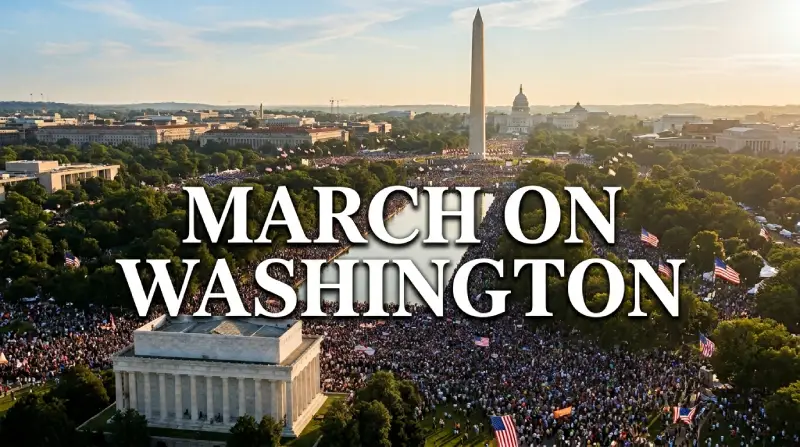
The march route stretched from the Washington Monument to the Lincoln Memorial. Participants carried signs demanding voting rights and fair wages. Furthermore, the atmosphere combined the gravity of protest with the spirit of collective purpose.
The “I Have a Dream” Speech: History Made at the Lincoln Memorial
Martin Luther King Jr. closed the program as the final speaker of the day. He spoke for 17 minutes from the steps of the Lincoln Memorial, addressing a crowd of over 250,000. Historians now recognize it as one of the greatest speeches in the English language.
However, what makes the speech extraordinary is the story behind its most celebrated passage. King largely improvised that section on the spot. Gospel singer Mahalia Jackson, seated just behind him, called out “Tell ’em about the dream, Martin!” King set aside his prepared text and spoke freely. The words that followed invoked a vision of children of different races living together in dignity and freedom. That improvised passage defined the moral aspirations of the civil rights movement for generations.
King built the speech around three foundational American documents: the Declaration of Independence, the Emancipation Proclamation, and the U.S. Constitution. He framed racial inequality as a “bad check” — a promissory note America had returned marked “insufficient funds.” He then called for redemption through justice.
Television broadcast the speech live to millions of American homes. Thus, the March on Washington became one of the first major political events to receive full national television coverage.
Legislative Impact: How the March on Washington Changed American Law
The March on Washington was not only a moral statement — it was a political catalyst. Its direct legislative consequences shaped two of the most consequential laws in American history:
- Civil Rights Act of 1964 — President Lyndon B. Johnson signed it into law on July 2, 1964. The act outlawed discrimination based on race, color, religion, sex, or national origin in employment, public accommodations, and federally assisted programs.
- Voting Rights Act of 1965 — Johnson signed it on August 6, 1965. The act dismantled the legal architecture of voter suppression. Specifically, it banned discriminatory practices like literacy tests that states had used to disenfranchise Black voters across the South.
Following the march, President John F. Kennedy and Vice President Johnson personally met King and the other Big Six leaders at the White House. Kennedy had initially been cool toward the march. Nevertheless, he acknowledged its power and its role in building political momentum for civil rights legislation.
The Unfinished Agenda
Despite these landmark achievements, the march’s goals remain incompletely realized. In 2013, the U.S. Supreme Court issued its decision in Shelby County v. Holder. That ruling invalidated a core enforcement mechanism of the Voting Rights Act. As a result, states with documented histories of voter suppression gained the ability to enact restrictive voting laws without federal preclearance.
Racial economic inequality — the “jobs” half of the march’s central demand — also persists. The median wealth gap between Black and white American families has actually widened since 1963 in absolute terms. This is true even as civil rights law has expanded. Therefore, these unresolved tensions explain precisely why annual commemorations of the march retain their urgency.
Annual Commemorations of the March on Washington
Civil rights organizations commemorate the March on Washington every year, with events centered on or near August 28. August is a historically significant month for American civil rights. However, because weekday dates limit public participation, organizers typically schedule major commemorations on the nearest Saturday. You can explore all holidays in August to plan around other key dates that month.
Milestone anniversaries draw especially large crowds and national media attention:
- 20th Anniversary (1983) — Organizers held it on August 27, 1983, at the Lincoln Memorial
- 50th Anniversary (2013) — A major national rally drew tens of thousands to Washington
- 60th Anniversary (2023) — The event took place on August 26, 2023. An estimated 75,000 participants marched from Lincoln Circle NW to the Martin Luther King Jr. Memorial
Commemorative events typically include rallies at the Lincoln Memorial and marches toward the U.S. Capitol or the MLK Memorial. Additionally, organizers bring in speeches from civil rights leaders, elected officials, and labor union contingents, alongside cultural programming and calls to action on voting rights.
The 70th Anniversary in 2033 is on track to become a major national mobilization, comparable in scale to the 50th and 60th commemorations.
2027 stands out clearly. August 28 falls on a Saturday that year. Consequently, organizers can hold commemorations on the exact anniversary date without any scheduling adjustment.
How to Commemorate the March on Washington
Whether you are near Washington, D.C., or located across the country, there are several meaningful ways to mark the anniversary of the March on Washington:
- Attend the annual Lincoln Memorial rally — Events are typically organized by the NAACP, AFL-CIO, National Action Network, and allied civil rights coalitions; check official websites for confirmed dates each year
- Visit the Martin Luther King Jr. Memorial — Located at 1964 Independence Ave SW, Washington, D.C., on the National Mall, open daily
- Watch archival footage — The full march and King’s speech are preserved at the Library of Congress and the National Archives
- Engage locally — Cities across the United States hold commemorative events, panel discussions, and film screenings around August 28
- Support voting rights organizations — The NAACP Legal Defense Fund and Democracy Docket continue the legal work the march inspired
FAQ: March on Washington
When did the March on Washington take place?
The March on Washington for Jobs and Freedom took place on August 28, 1963, in Washington, D.C. Annual commemorations are held on or near August 28 each year, typically scheduled on the nearest Saturday to maximize participation.
Why is the March on Washington historically significant?
The March on Washington was the largest civil rights demonstration in American history at the time, attended by approximately 250,000 people. It directly contributed to the passage of the Civil Rights Act of 1964 and the Voting Rights Act of 1965, and it gave the world Martin Luther King Jr.’s “I Have a Dream” speech.
Who organized the March on Washington?
The march was organized by A. Philip Randolph and Bayard Rustin, with public leadership from the “Big Six” civil rights organizations: the SCLC, CORE, SNCC, Brotherhood of Sleeping Car Porters, NAACP, and National Urban League.
What were the six demands of the March on Washington?
The six demands were: a comprehensive civil rights bill, protection of voting rights, an executive order ending racial discrimination in federal employment, desegregation of all public schools, a federal full employment program, and a fair federal minimum wage for all workers.
How many people attended the March on Washington in 1963?
Official estimates placed attendance at approximately 250,000 people, with some estimates ranging from 200,000 to 300,000. It was the largest political rally held in Washington, D.C., to that point in American history.
Was the “I Have a Dream” speech written in advance?
Martin Luther King Jr. prepared a written speech, but the most famous passage — the “I Have a Dream” section — was largely improvised. Gospel singer Mahalia Jackson called out from behind him, prompting King to set aside his notes and speak freely about his vision of racial harmony and justice.
Is the March on Washington commemorated every year?
Yes. Civil rights and labor organizations hold annual events near August 28. Major milestone anniversaries — including the 20th (1983), 50th (2013), and 60th (2023) — draw especially large crowds, with the 60th anniversary attracting an estimated 75,000 participants.
What legislation resulted from the March on Washington?
The march directly influenced the passage of the Civil Rights Act of 1964 and the Voting Rights Act of 1965, two of the most consequential pieces of civil rights legislation in United States history.
When is the next major anniversary of the March on Washington?
The 70th anniversary falls in 2033 and is expected to be a major national commemorative event. Within the next five years, 2027 is the most significant date, as August 28 falls on a Saturday — allowing commemorations to take place on the exact anniversary.
Where can I watch the original March on Washington?
Archival footage of the march and King’s speech is preserved and accessible through the Library of Congress Civil Rights History Project and the Smithsonian National Museum of African American History and Culture.
The March on Washington for Jobs and Freedom remains a living event, not a closed chapter. Its demands — economic justice, voting rights, equality under law — continue to animate American political life. More than six decades have passed since 250,000 people gathered on the National Mall on August 28, 1963. However, the call first raised by Randolph, Rustin, King, Lewis, and their fellow organizers still rings true: democracy is not a destination — it is an ongoing commitment.
Mark your calendar for August 28. In particular, mark August 28, 2027, when the exact anniversary falls on a Saturday, offering a rare chance for broad national participation. Whether you attend a rally, visit the Martin Luther King Jr. Memorial, or engage with commemorative events in your own city, the march’s history and its unfinished agenda are worth honoring.
Upcoming Holidays And Celebrations:
| Date | Type | Name |
|---|---|---|
| 27 September 2026 | Event | Gold Star Mother's Day 2026 |
| 27 September 2026 | Event | International Daughters Day 2026 |
| 27 September 2026 | Event | World Tourism Day |
| 28 September 2026 | Event | International Daughters Day |
| 28 September 2026 | National day | National Neighbor Day 2026 |
| 28 September 2026 | National day | National Sons Day |
| 29 September 2026 | Event | Michaelmas 2026 |
| 29 September 2026 | Event | Veterans of Foreign Wars - VFW 2026 |
| 29 September 2026 | Event | World Heart Day |
| 29 September 2026 | National day | National Coffee Day |
| 30 September 2026 | National day | National Day for Truth and Reconciliation |
| 01 October 2026 | Event | ADHD Awareness Month |
| 01 October 2026 | Event | Breast Cancer Awareness Month |
| 01 October 2026 | Event | Filipino American History Month |
| 01 October 2026 | Event | International Coffee Day |
| 01 October 2026 | Event | International Day of Older Persons |
| 01 October 2026 | Event | International Music Day |
| 01 October 2026 | Event | World Vegetarian Day |
| 02 October 2026 | Event | World Smile Day |
| 02 October 2026 | National day | National Custodian Day |

Chokri Hamouda runs Calendarena.com. He makes simple, printable calendar templates. His goal is to help people organize their time better. He updates the site with monthly and yearly calendars for users worldwide. Chokri focuses on making calendars that are easy to read and use. He also researches holidays and date systems to keep everything accurate.