Time Converter – Convert Seconds, Minutes, Hours, Days & More
Calendarena offers a free online time conversion tool to instantly convert seconds, minutes, hours, days, weeks, months, and years accurately.
Whether you need to convert seconds to minutes, hours, days, or any other time unit combination, this utility delivers accurate results in seconds. Perfect for students, professionals, developers, and anyone who needs quick time conversions for work, school, coding, or daily planning.
1 Days = 0.1429 Weeks
Common Uses for This Time Conversion Tool
- Employee payroll calculations
- Freelance work tracking
- School and study planning
- Workout duration tracking
- Project management scheduling
- Scientific and engineering calculations
Convert Time Units Instantly
Enter any time value in the field above, select your input and output units, and get instant conversion results. The calculator supports all standard time units from seconds to years.
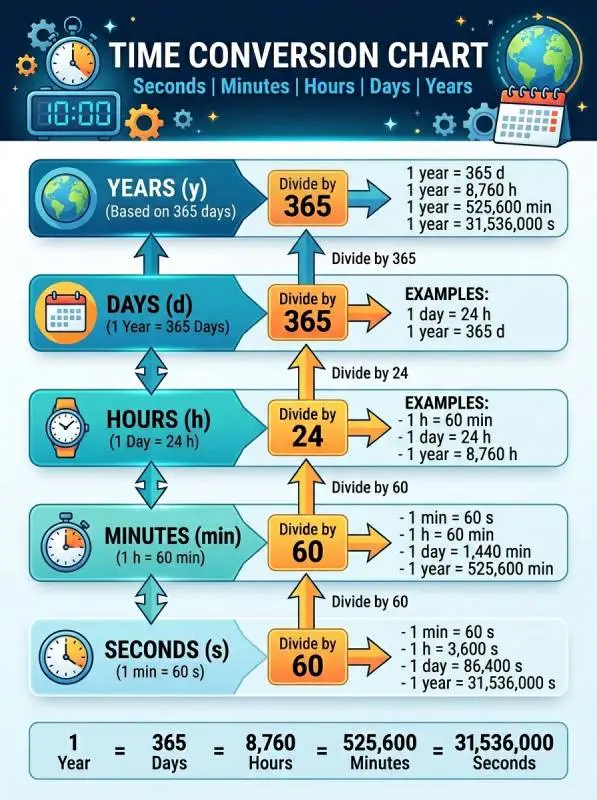
Supported Time Units
Our time converter supports the following units:
- Seconds (s) – Base unit of time
- Minutes (min) – 60 seconds
- Hours (h) – 60 minutes
- Days (d) – 24 hours
- Weeks (wk) – 7 days
- Months (mo) – Average of 30.44 days
- Years (yr) – 365 days (standard year)
Month and year conversions use standard averages since these units vary in actual length. For exact calculations involving specific months or leap years, additional precision may be needed.
How Time Conversion Works
Time conversion works by understanding the fixed relationships between time units. Each minute contains exactly 60 seconds, each hour contains exactly 60 minutes, and each day contains exactly 24 hours. These conversions are precise and consistent.
However, conversions involving months and years use standard averages because these units vary in length. A standard month is calculated as 30.44 days (365 ÷ 12), and a standard year is 365 days. For most practical purposes, these averages provide sufficiently accurate results.
The converter uses seconds as the base unit for most calculations. When you convert between larger units like hours and days, the calculator first converts your input to seconds, performs the calculation, then converts to your desired output unit. This ensures accuracy across all conversion types.
Common Time Conversion Formulas
Use these formulas to convert between common time units:
Basic conversions:
- Minutes = Seconds ÷ 60
- Hours = Minutes ÷ 60
- Days = Hours ÷ 24
- Weeks = Days ÷ 7
- Months = Days ÷ 30.44
- Years = Days ÷ 365
Reverse conversions:
- Seconds = Minutes × 60
- Minutes = Hours × 60
- Hours = Days × 24
- Days = Weeks × 7
- Days = Months × 30.44
- Days = Years × 365
These formulas work for any whole or decimal value. The converter applies these formulas automatically to give you instant results.
Time Conversion Examples
Here are practical examples to help you understand time conversions:
90 minutes = 1.5 hours
A typical movie runtime converted to hours.
48 hours = 2 days
A weekend work shift converted to days.
10,000 seconds ≈ 2.78 hours
Video content duration converted to hours.
336 hours = 2 weeks
Vacation time converted from hours to weeks.
1,000,000 seconds ≈ 11.57 days
A large time value put in perspective.
365 days = 52.14 weeks
A standard year expressed in weeks.
Popular Time Conversion Examples
Here are some of the most common time conversions used by our visitors:
- Seconds to Minutes: Divide seconds by 60 (e.g., 360s = 6 mins)
- Hours to Days: Divide hours by 24 (e.g., 48h = 2 days)
- Weeks to Months: Divide weeks by 4.345 (e.g., 52 weeks ≈ 12 months)
- Years to Days: Multiply years by 365 (e.g., 2 years = 730 days)
Frequently Asked Questions About Time Conversion
What is a time converter?
A time converter is a utility that transforms time values from one unit to another, such as converting seconds to minutes or hours to days. The converter performs automatic calculations using standard time unit relationships to provide instant, accurate results.
Are time conversions always exact?
Conversions between seconds, minutes, hours, days, and weeks are always exact because these units have fixed relationships. Conversions involving months and years use standard averages (30.44 days per month, 365 days per year) and may be slightly approximate depending on the specific dates involved.
What is the smallest unit of time?
In everyday use, the second is the standard smallest unit. However, time can be measured in smaller units like milliseconds (1/1000 of a second), microseconds (1/1,000,000 of a second), and even smaller divisions used in scientific applications.
Why do months have different lengths?
Months vary in length due to the historical development of calendars, ranging from 28 days (February in common years) to 31 days. For time conversion purposes, a standard month is calculated as approximately 30.44 days, which is the average length across all months (365 days ÷ 12 months).
Is a year always 365 days?
A standard year is 365 days, but a leap year contains 366 days and occurs every four years (with some exceptions). For general time conversions, 365 days is used as the standard year length.
Can I convert decimal values?
Yes, this time converter accepts decimal values. For example, you can convert 1.5 hours to minutes (90 minutes) or 2.5 days to hours (60 hours). Decimal conversions are useful for precise calculations.
Is this time converter accurate?
Yes, this converter uses precise mathematical formulas for all conversions. Fixed unit conversions (seconds, minutes, hours, days, weeks) are exact, while month and year conversions use industry-standard averages for consistent results.
| Conversion | Result |
|---|---|
| 1 hour | 60 minutes |
| 1 day | 24 hours |
| 1 week | 7 days |
Why Use Our Time Converter?
This time converter offers several advantages for quick and accurate time unit conversions:
- Free & Online – No cost, no downloads, no installation required
- No Signup – Use the utility instantly without creating an account
- Instant Results – Get conversions in real-time as you type
- All Devices – Works seamlessly on desktop, tablet, and mobile
- Accurate Formulas – Uses precise mathematical calculations
- Multiple Units – Supports seven common time units
- Bidirectional – Convert in any direction between units