
Women’s Equality Day: History, Significance & How to Celebrate
Women’s Equality Day is observed every year on August 26 in the United States, commemorating the 1920 certification of the 19th Amendment — the constitutional provision that granted American women the right to vote. Far more than a historical footnote, this annual observance celebrates decades of hard-won progress and calls attention to the work still ahead for gender equality in education, employment, politics, and public life.
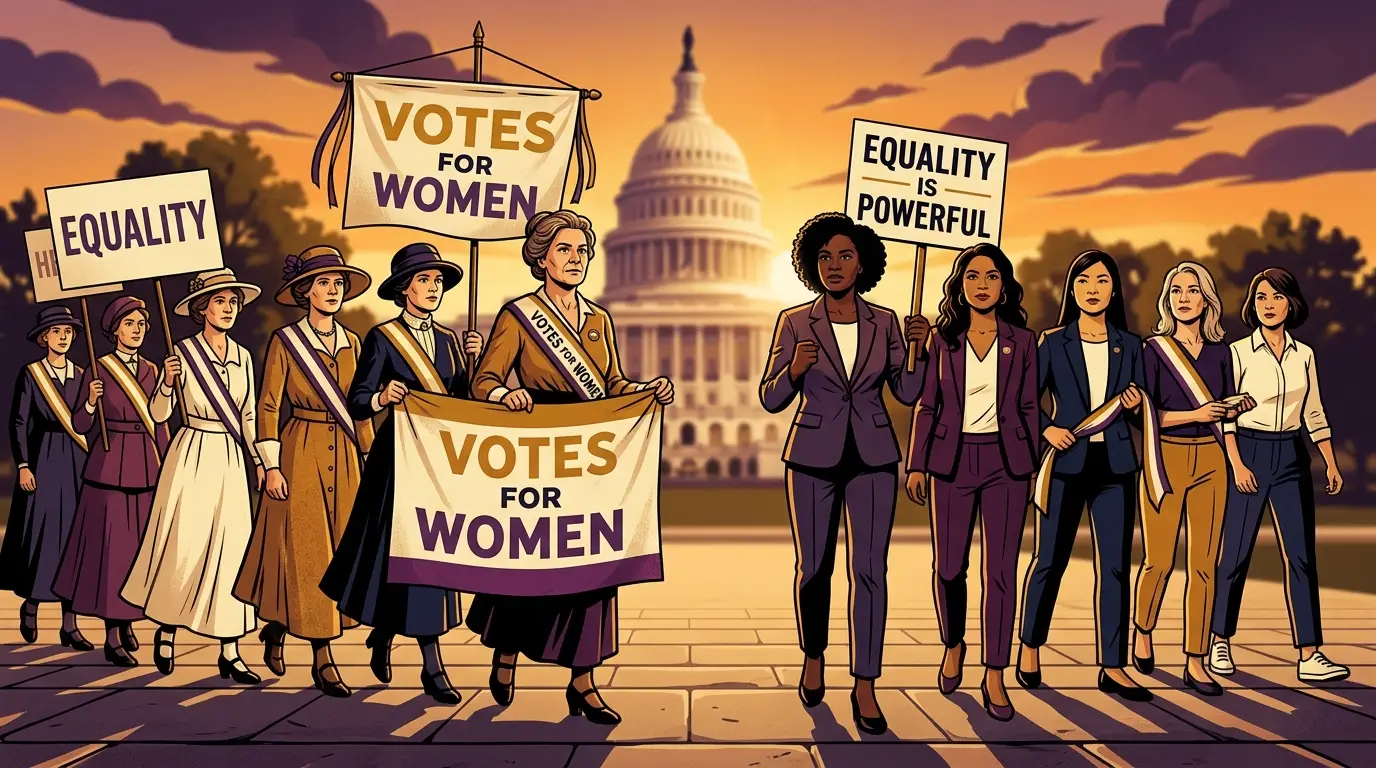
Whether you are discovering this day for the first time or looking to deepen your understanding of its origins, this complete guide covers everything: the history of Women’s Equality Day, key legislative milestones, upcoming dates through 2030, and concrete ways to mark August 26 with meaning.Chek our August 2026 Calendar for more national days
What Is Women’s Equality Day?
Women’s Equality Day is an official U.S. observance — not a federal public holiday — proclaimed each year by the President of the United States. Every administration since the early 1970s has maintained this tradition, underscoring the day’s enduring civic importance.
The observance is rooted in suffrage but has evolved considerably. Today, Women’s Equality Day serves as a platform for raising awareness about the gender pay gap, reproductive rights, political representation, gender-based violence, and the intersectional barriers faced by women of colour, immigrant women, and women from lower socioeconomic backgrounds.
The Historical Roots of Women’s Equality Day
From Seneca Falls to the 19th Amendment
The story of Women’s Equality Day begins long before August 26, 1920. The modern women’s rights movement traces its formal origins to the Seneca Falls Convention of July 19–20, 1848, organised by Elizabeth Cady Stanton and Lucretia Mott. It was the first women’s rights convention in U.S. history, producing the “Declaration of Sentiments” — a document that sparked more than seven decades of suffragist activism.
Congress passed the 19th Amendment on June 4, 1919, after generations of petitions, protests, marches, and civil disobedience. Tennessee became the decisive 36th state to ratify it on August 18, 1920. U.S. Secretary of State Bainbridge Colby formally certified the ratification on August 26, 1920, making that date the legal birth of women’s suffrage in America.
Key Legislative Milestones
| Year | Milestone |
|---|---|
| 1848 | Seneca Falls Convention produces the “Declaration of Sentiments” |
| 1869 | Wyoming passes America’s first women’s suffrage law |
| 1872 | Susan B. Anthony arrested for voting; fined $100 she refused to pay |
| 1919 | Congress passes the 19th Amendment |
| 1920 | 19th Amendment ratified; approximately 26 million women enfranchised |
| 1963 | Equal Pay Act prohibits sex-based wage discrimination |
| 1964 | Title VII of the Civil Rights Act bans employment discrimination based on sex |
| 1966 | Betty Friedan co-founds the National Organization for Women (NOW) |
| 1997 | Madeleine Albright becomes the first female U.S. Secretary of State |
| 2007 | Nancy Pelosi becomes the first female Speaker of the U.S. House |
| 2013 | U.S. military removes its ban on women in combat positions |
| 2021 | Kamala Harris becomes the first female Vice President of the United States |
How August 26 Became an Official Observance
The journey from ratification to official recognition unfolded over half a century.
In 1970, more than 100,000 women participated in the Women’s Strike for Equality across over 90 U.S. cities — the largest gender-equality protest in American history at that time. The momentum was impossible to ignore.
In 1971, Congresswoman Bella Abzug of New York introduced a resolution to designate August 26 as “Women’s Equality Day.” Abzug was one of the most outspoken advocates for women’s rights in the U.S. Congress, and her push directly led to the day’s formal recognition.
In 1972, President Richard Nixon issued Proclamation 4147 — the first official presidential proclamation — initially designating August 26 as “Women’s Rights Day.” Congress followed in 1973 by formally approving H.J. Res. 52, cementing the name Women’s Equality Day and establishing the annual presidential proclamation tradition that continues today.
The 19th Amendment: Essential Facts
The 19th Amendment is the legal cornerstone that Women’s Equality Day commemorates. Understanding its scope and limitations is essential to appreciating why the observance still matters.
The amendment was first introduced to the U.S. Constitution in 1878 — more than 40 years before its adoption. When it finally passed, it enfranchised approximately 26 million American women in time for the 1920 presidential election. Yet only 36% of eligible women voted that year, compared to 68% of men, due to literacy tests, poll taxes, and deep social barriers.
Progress accelerated steadily. By 1960, women were turning out to vote in presidential elections in greater numbers than men — a trend that has continued ever since. However, the amendment’s protections were far from universal at its ratification. Black, Asian American, Hispanic, and Native American women continued to face systemic discrimination at polling stations for decades afterward, a legacy that intersectional advocacy efforts continue to address.
Women’s Equality Day: Upcoming Dates 2026–2030
Women’s Equality Day falls on August 26 every year, regardless of the day of the week. Since the observance is not a federal holiday, workplaces, schools, and community organisations hold events on or around the date. Here are the upcoming observances:
| Year | Date | Day of the Week |
|---|---|---|
| 2026 | August 26, 2026 | Wednesday |
| 2027 | August 26, 2027 | Thursday |
| 2028 | August 26, 2028 | Saturday |
| 2029 | August 26, 2029 | Sunday |
| 2030 | August 26, 2030 | Monday |
Women’s Equality Day vs. International Women’s Day
Many people conflate these two important observances. They share a common spirit but differ significantly in origin, scope, and focus.
| Feature | Women’s Equality Day | International Women’s Day |
|---|---|---|
| Date | August 26 | March 8 |
| Origin | United States, 1971 | International, 1911 |
| Focus | 19th Amendment and voting rights | Global gender equality |
| Geographic scope | Primarily U.S.-based | Worldwide |
| Official status | U.S. Presidential Proclamation | UN-recognized global observance |
Women’s Equality Day is explicitly tied to the American suffrage story and the legal text of the 19th Amendment. International Women’s Day, observed on March 8 every year, takes a broader global lens, spotlighting women’s rights, labour rights, and gender justice across every country and culture.
Why Women’s Equality Day Still Matters Today
Gaining the right to vote was monumental — but Women’s Equality Day is a reminder that suffrage was a beginning, not an endpoint. The day invites reflection on how far society has come and how far it still has to go.
Key issues that Women’s Equality Day amplifies today include the persistent gender pay gap, where women continue to earn less than men in comparable roles; debates around reproductive rights and bodily autonomy; the underrepresentation of women in politics, corporate leadership, and STEM fields; ongoing gender-based violence and the need for stronger legal protections; and intersectional inequality, where the compounding effects of race, class, and gender create distinct and layered barriers.
The day also acknowledges that the 19th Amendment, despite its landmark status, did not fully protect all women. This history makes Women’s Equality Day a space for accountability as much as celebration.
How to Celebrate Women’s Equality Day
Whether you are an individual, a family, or an organisation, there are many meaningful ways to mark August 26.
Learn the history. Watch a documentary about the suffrage movement, read a biography of Susan B. Anthony or Bella Abzug, or explore the National Archives’ 19th Amendment resources — one of the most authoritative sources on the amendment’s journey to ratification.
Host a community event. Organise a panel discussion, a film screening, or a book club centred on women’s rights literature. These formats spark dialogue and deepen understanding across generations.
Recognise women in your workplace. Launch an internal recognition programme, invite a guest speaker, or hold a roundtable on gender equity in your sector. Workplace observances normalise the conversation year-round.
Support women-led organisations. Donate to nonprofits advancing women’s education, safety, and economic independence. Organisations like the Brennan Center for Justice offer extensive research on voting rights as well.
Amplify the day on social media. Share facts, timelines, and personal stories using hashtags like #WomensEqualityDay and #August26 to extend awareness beyond your immediate community.
Frequently Asked Questions About Women’s Equality Day
When is Women’s Equality Day?
Women’s Equality Day is observed every year on August 26 in the United States. The date marks the 1920 certification of the 19th Amendment to the U.S. Constitution, which established women’s constitutional right to vote. The observance falls on August 26 regardless of the day of the week.
What does Women’s Equality Day commemorate?
Women’s Equality Day commemorates the certification of the 19th Amendment on August 26, 1920, by U.S. Secretary of State Bainbridge Colby. That certification made women’s suffrage constitutional law in the United States, enfranchising approximately 26 million American women in time for the 1920 presidential election.
Who created Women’s Equality Day?
Congresswoman Bella Abzug of New York introduced the original resolution in 1971 to designate August 26 as Women’s Equality Day. Congress formally approved it in 1973 via H.J. Res. 52. President Nixon was the first to issue an official presidential proclamation in 1972.
Is Women’s Equality Day a federal holiday?
No. Women’s Equality Day is an official U.S. observance but not a federal public holiday. Government offices and most businesses remain open. Observances take place through community events, workplace programmes, educational campaigns, and social media awareness efforts.
What is the difference between Women’s Equality Day and International Women’s Day?
Women’s Equality Day (August 26) is a U.S.-specific observance directly tied to the ratification of the 19th Amendment and American voting rights history. International Women’s Day (March 8) is a globally recognised day, acknowledged by the United Nations, that focuses on broader gender equality issues worldwide across all countries and cultures.
Why is August 26 the chosen date for Women’s Equality Day?
August 26 is the date in 1920 on which U.S. Secretary of State Bainbridge Colby certified the ratification of the 19th Amendment, making women’s right to vote part of the U.S. Constitution. Bella Abzug’s 1971 resolution chose this date deliberately to honour that moment of constitutional transformation.
How many women did the 19th Amendment enfranchise?
The 19th Amendment enfranchised approximately 26 million American women in time for the 1920 presidential election. Despite this, voter turnout among newly eligible women was initially lower than among men, largely due to literacy tests, poll taxes, and entrenched social barriers that continued to suppress participation.
Who was Bella Abzug?
Bella Abzug was a U.S. Congresswoman from New York and a leading advocate for women’s rights, civil rights, and peace activism. She introduced the original 1971 resolution to designate August 26 as Women’s Equality Day, and her tireless legislative work was instrumental in securing the day’s formal recognition by Congress in 1973.
Women’s Equality Day, observed every August 26, is one of the most significant civic observances in the United States. It honours the long and difficult road to the 19th Amendment, celebrates the women and allies who made suffrage possible, and keeps the conversation about gender equality alive for new generations.
From the Seneca Falls Convention of 1848 to Kamala Harris’s historic inauguration as Vice President in 2021, the arc of women’s progress in America is a story of persistence, courage, and collective action. Women’s Equality Day is a moment to acknowledge that arc — and to recommit to the work still ahead.