
⚡ Quick Answer: How Many Weeks in a Year?
- Weeks in a Standard Year: 52 Weeks + 1 Day
- Weeks in a Leap Year (2024): 52 Weeks + 2 Days
- Exact Math: 365 ÷ 7 = 52.142857 weeks
- 2026: 52 Weeks + 1 Day (261 working days)
- ISO 53-Week Year: 2026 qualifies under ISO 8601
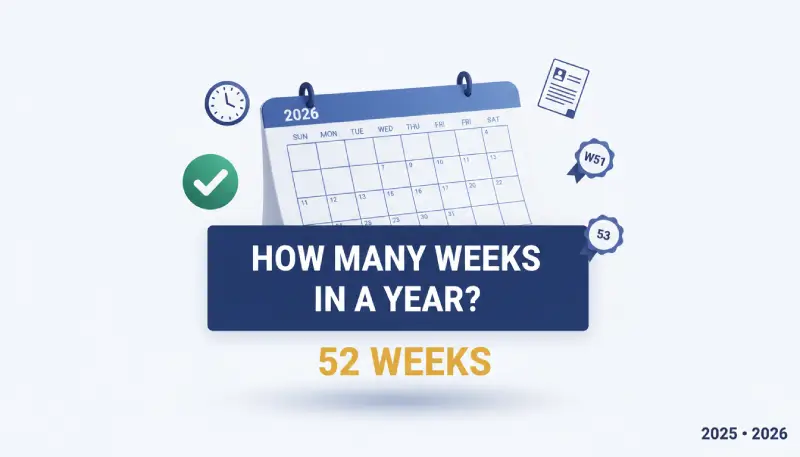
How Many Weeks in a Year? (2025 & 2026 Complete Guide)
Last Updated: February 2026
So, how many weeks in a year? The short answer: 52 weeks, plus one or two extra days depending on whether it is a leap year. Divide 365 by 7 and you get 52.142857 — meaning no calendar year fits into a perfect round number of weeks.
👉 [Use Our Free Week Number Calculator →]
Counting weeks carefully matters beyond the calendar. If you’re tracking a pregnancy, our pregnancy calculator week by week uses the same 7-day week math to give you an accurate due date and trimester breakdown.
The Math Behind the Calendar
Understanding how many weeks in a year starts with a simple division: 365 ÷ 7 = 52.142857. That decimal remainder — 0.142857 of a week — equals exactly one leftover day every standard year.
That orphaned extra day is why January 1st shifts to a different weekday each year. If a year starts on Thursday, it ends on Thursday too, meaning Thursday appears 53 times while every other weekday appears 52 times. This is a built-in structural property of the Gregorian calendar system, not a calendar flaw.
How Many Weeks in a Leap Year?
A leap year has 366 days, which means 52 weeks + 2 extra days. The most recent leap year was 2024 — it began on Monday and ended on Tuesday, so both Monday and Tuesday each appeared 53 times that year.
How many weeks in a year varies slightly depending on the year type:
| Year | Days | Leap Year? | Weeks | Extra Days |
|---|---|---|---|---|
| 2024 | 366 | ✅ Yes | 52 | 2 (Mon + Tue) |
| 2025 | 365 | ❌ No | 52 | 1 (Wed) |
| 2026 | 365 | ❌ No | 52 | 1 (Thu) |
| 2027 | 365 | ❌ No | 52 | 1 (Fri) |
| 2028 | 366 | ✅ Yes | 52 | 2 (Sat + Sun) |
For payroll and HR teams, a leap year with two extra weekdays can add unbudgeted labor cost — a detail that annual financial planning must account for.
How Many Working Weeks in a Year?
Many people search how many weeks in a year specifically for payroll and business scheduling. A working week is Monday–Friday (5 days). Here is the formula:
Working days = (52 × 5) + extra weekday days
For 2026: January 1st falls on Thursday — the one extra day is a weekday — giving 261 working days, or 52.2 working weeks.
The 260 / 261 / 262 Working Days Phenomenon
The number of working days shifts every year based on where the extra day(s) land:
- 260 working days — extra day(s) fall on a weekend
- 261 working days — most common; one extra weekday (e.g., 2025, 2026)
- 262 working days — leap year where both extra days are weekdays
After removing the standard 10 US federal public holidays, 2026 yields approximately 251 net working days — roughly 50.2 effective working weeks.
Payroll Pro Tip: Bi-weekly payroll runs 26 pay periods per year. But 26 × 14 = 364 days — one day short of 365. Every 5–6 years this creates a 27th paycheck year, which HR teams must plan for in advance. Learn more at the U.S. Office of Personnel Management Payroll Calendar.
ISO 8601 vs. the US Calendar: The 53-Week Year
This is the section most articles skip — and it is exactly what accounting and finance professionals need to know.
Under ISO 8601 — the international standard used in ERP systems, finance, and EU business — every week starts on Monday, and Week 1 is always the week that contains the first Thursday of the year.
Because of this rule, some ISO years officially have a Week 53. This occurs when January 1st falls on a Thursday (common year) or on Wednesday/Thursday (leap year). Out of every 400 years in the Gregorian cycle, exactly 71 years contain an ISO Week 53.
Is 2026 a 53-week ISO year? Yes. January 1, 2026 is a Thursday — triggering an ISO Week 53 carry-over. Finance systems using ISO week numbering will show W53 in their January reports.
| Feature | ISO 8601 | US Calendar |
|---|---|---|
| Week starts | Monday | Sunday |
| Week 1 definition | Contains first Thursday | Contains January 1 |
| 53-week years | 71 out of 400 years | Defined differently |
| Used by | EU, finance, ERP, ISO | North America (general) |
| 2026 ISO weeks | 53 | 52 + 1 day |
- The 7-day week predates the Gregorian calendar — it traces to Babylonian astronomy, associating each day with a visible celestial body (Sun, Moon, Mars, Mercury, Jupiter, Venus, Saturn).
- Over a full 400-year Gregorian cycle, there are exactly 20,871 weeks — a perfectly whole number.
- The Moon completes ~13 lunar cycles per year (29.5 days each), which is why some ancient civilizations used 13-month calendars.
- In 2026, Thursday is the weekday that appears 53 times — all other days appear 52 times.
- US retailers using a 52/53-week fiscal year must rebase year-over-year comparisons in any 53-week year, since Q4 revenue is artificially inflated by one extra selling week.
Frequently Asked Questions
How many weeks in a year exactly?
A standard year contains exactly 52 weeks and 1 day (52.142857 weeks). A leap year contains 52 weeks and 2 days (52.285714 weeks).
Does a year have 52 or 53 weeks?
A Gregorian calendar year always has 52 weeks plus extra days. However, under the ISO 8601 standard used in business and finance, some years officially contain 53 numbered weeks — 2026 is one of them.
How many working weeks are in 2026?
2026 has 261 working days (before holidays), or roughly 50.2 effective working weeks after removing 10 US federal holidays.
Is 2026 a leap year?
No. 2026 is a standard 365-day year. The next leap year is 2028.
Why do accounting systems show 53 weeks in 2026?
Because ISO 8601 designates Week 1 as the week containing the first Thursday of the year. Since January 1, 2026 is a Thursday, ISO-compliant systems assign it a Week 53 carry-over, giving 2026 an official count of 53 ISO weeks.