When is Juneteenth 2026?
Juneteenth falls on Friday, June 19, 2026. As a U.S. federal holiday, most government offices, banks, and post offices will be closed. It commemorates June 19, 1865 — the day Union troops arrived in Galveston, Texas, and delivered freedom to the last enslaved people in the Confederacy, more than two and a half years after the Emancipation Proclamation.
Juneteenth, also known as Freedom Day or Emancipation Day, is the oldest nationally celebrated commemoration of the end of slavery in the United States. It marks June 19, 1865, when Union soldiers arrived in Galveston, Texas, and announced that the Civil War had ended and enslaved African Americans were free — an announcement that came more than two and a half years after President Abraham Lincoln signed the Emancipation Proclamation.
In this guide, we cover everything you need to know: the exact dates for 2026 and beyond, the powerful history behind the holiday, how different states observe it, traditional and modern ways to celebrate, and a comprehensive FAQ section built to answer the questions people are actually searching for.
Juneteenth — Upcoming Dates
- Thursday, June 19, 2025
- Friday, June 19, 2026 (this year)
- Saturday, June 19, 2027 — observed Friday, June 18
- Monday, June 19, 2028
The History Behind Juneteenth
The Emancipation Proclamation: The Declaration Without Delivery
The story of Juneteenth begins on January 1, 1863, when President Abraham Lincoln signed the Emancipation Proclamation. The order declared all enslaved people in Confederate states to be legally free — but freedom on paper and freedom in practice were very different things. The proclamation had no enforcement mechanism in areas still controlled by Confederate forces, and relied entirely on Union military victories to become real.
Texas, geographically remote and largely untouched by Union troops throughout the war, became the final holdout. Slaveholders there actively suppressed news of the proclamation, forcing enslaved people to continue their labor under false pretenses for more than two years.
June 19, 1865: General Order No. 3
On June 19, 1865, Union Major General Gordon Granger arrived in Galveston, Texas, with approximately 2,000 federal troops. He issued General Order No. 3 — the military directive that would become the founding document of Juneteenth.
“The people of Texas are informed that, in accordance with a proclamation from the Executive of the United States, all slaves are free. This involves an absolute equality of personal rights and rights of property between former masters and slaves…”
— General Order No. 3, Maj. Gen. Gordon Granger, June 19, 1865
This moment — not January 1, 1863 — is when freedom became a lived reality for the estimated 250,000 enslaved people in Texas. It is why Juneteenth is celebrated on June 19, and why it carries such profound historical weight.
Why Is Juneteenth Called the “Second Independence Day”?
The phrase “Second Independence Day” has become one of Juneteenth’s most powerful identifiers. The Declaration of Independence in 1776 proclaimed that “all men are created equal” — but enslaved African Americans were explicitly excluded from that promise. Juneteenth marks the moment when the United States came meaningfully closer to honoring its founding ideals for all of its people. For many Americans, June 19th carries equal or greater moral significance than July 4th, precisely because it represents the fulfillment of a promise long denied.
Why Did It Take So Long for Texas to Hear the News?
Texas, due to its isolation and lack of Union presence during much of the Civil War, did not immediately feel the effects of the Emancipation Proclamation. Additionally, many slaveholders deliberately withheld the information to maintain control over the enslaved population for as long as possible. The arrival of Union troops in June 1865 marked the end of this era of oppression.
The Emancipation Proclamation and Its Impact
The Emancipation Proclamation was a key milestone in the fight to end slavery, but its immediate impact was limited. It only applied to states that were in rebellion against the Union, and not to border states or rebel areas already under Union control. Its enforcement relied heavily on Union military victories.
Although it laid the groundwork for the eventual abolition of slavery, true freedom came for many enslaved individuals only when Union troops arrived to enforce the law. Juneteenth stands as the symbolic day when freedom was finally realized by all African Americans.
Celebrating Juneteenth: Traditions and Customs
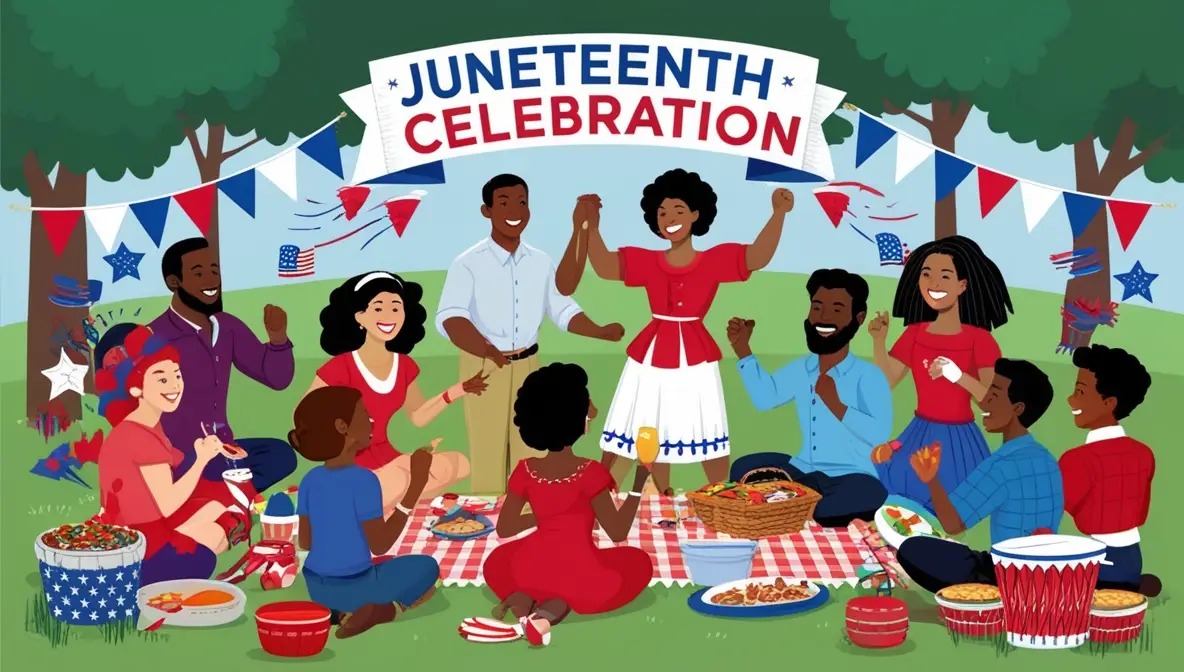
Juneteenth celebrations date back to 1866 — just one year after emancipation — when formerly enslaved Texans organized the first gatherings. Over more than 150 years, these traditions have grown from small community events into large, nationally recognized celebrations.
Traditional Juneteenth Activities
- Reading of the Emancipation Proclamation & General Order No. 3 — A cornerstone of early celebrations, still practiced at formal events and churches today.
- Red Foods & Drinks — Red soda water, hibiscus tea, red velvet cake, strawberry pie, and red beans are served as a direct cultural link to West African traditions, where red foods held ceremonial significance. The color also symbolizes the bloodshed and resilience of those who fought for freedom.
- Barbecues & Picnics — Communal outdoor feasts are central to Juneteenth. The act of gathering freely to eat together held enormous symbolic power for newly emancipated communities.
- Family Reunions — Because slavery deliberately separated families, reunification became one of the most powerful expressions of freedom. Family reunion traditions remain a defining feature of Juneteenth to this day.
- Parades & Marches — Civic parades take place in cities across the country, often featuring community organizations, marching bands, and elected officials.
- Music, Dance & Poetry — From gospel and blues to spoken word, cultural performances connect the celebration to African American artistic tradition.
- Historical Reenactments — Some communities recreate the reading of General Order No. 3 or other pivotal moments in emancipation history.
A Modern Tradition for 2026: Supporting Black-Owned Businesses
One of the fastest-growing Juneteenth traditions is using the holiday as an intentional moment of economic empowerment. Practical ways to participate include purchasing gift cards in advance, leaving Google or Yelp reviews for businesses you already love, or discovering new ones through directories like Official Black Wall Street and WeBuyBlack, which offer searchable listings by category and location.
Juneteenth Symbols and Colors
The colors red, white, and blue run throughout Juneteenth symbolism, echoing the American flag to signal that African Americans were always part of the nation — even when the nation refused to acknowledge it. Red carries particular cultural weight: it represents both the bloodshed of those who fought for freedom and the West African ceremonial traditions that survived the Middle Passage.
The Juneteenth flag, designed in 1997 by activist Ben Haith and later refined with input from artist L.J. Graf, uses these colors with a curved horizon line dividing the field — symbolizing a new horizon of opportunity — and a central starburst called the “new star.” The star represents a new beginning for African Americans and signals that the light of freedom radiates outward to all 50 states.
How Different States Observe Juneteenth in 2026
While Juneteenth is a federal holiday, implementation at the state and employer level varies. Here is a snapshot of observance patterns across key states:
| State | State Holiday? | Employee Pay | Notable Local Tradition |
|---|---|---|---|
| Texas | Yes — since 1980 | Paid (state workers) | Galveston hosts the original celebration; Houston draws 100,000+ attendees |
| Washington D.C. | Yes | Paid (federal + DC workers) | National Mall celebrations, Smithsonian programming |
| Georgia | Yes | Paid (state workers) | Atlanta’s Centennial Olympic Park festival draws major acts |
| New York | Yes | Paid (state workers) | Brooklyn and Harlem host major street festivals |
| California | Yes | Paid (state workers) | Oakland’s Liberation Day celebration; LA festival in Leimert Park |
| North Dakota | No | Private employer varies | Growing community events in Fargo |
| South Dakota | No | Private employer varies | Community-organized observances in Sioux Falls |
| Montana | No | Private employer varies | Educational workshops at universities |
| All other states | Varies | Check with employer | Federal workers receive paid holiday regardless of state law |
Note: All federal employees receive Juneteenth as a paid holiday regardless of state designation. Private employer policies are set independently.
Juneteenth and the Civil Rights Movement
While Juneteenth originated as a celebration of emancipation, it evolved into a broader symbol of the ongoing fight for civil rights and social justice. During the Civil Rights Movement of the 1960s, the holiday became a rallying point for African Americans advocating for voting rights, an end to segregation, and equal protection under the law.
The holiday experienced a national resurgence following the 2020 protests against police brutality and systemic racism. Public awareness grew sharply, and the groundswell of advocacy that followed led directly to Juneteenth’s recognition as a federal holiday on June 17, 2021.
Juneteenth in Popular Culture
Juneteenth has become an increasingly prominent subject in literature, film, and music. Ralph Ellison’s novel Juneteenth explored race and identity in America, while the 2020 film Miss Juneteenth examined the intersection of the holiday with African American beauty pageant culture. Musicians and visual artists continue to pay tribute through works that celebrate freedom and confront ongoing inequality.
Why Juneteenth Matters Today
In today’s society, Juneteenth serves as a powerful reminder of the progress that has been made and the challenges that remain. As the nation continues to grapple with issues of systemic racism, police brutality, and inequality, Juneteenth provides an opportunity to reflect on the past and renew the commitment to building a more just and equitable future.
How to Honor Juneteenth in 2026
- Educate Yourself — Go beyond the basics. Read General Order No. 3. Explore first-person accounts from formerly enslaved people through the Federal Writers’ Project Slave Narratives at the Library of Congress.
- Attend or Organize Events — Find local Juneteenth festivals, parades, or educational workshops on Eventbrite or your city’s parks department website.
- Support Black-Owned Businesses — Use Official Black Wall Street or WeBuyBlack to find and patronize businesses in your area. Consider buying gift cards you can use throughout the year.
- Advocate for Racial Justice — Engage with local organizations working on issues of systemic inequality, criminal justice reform, and economic equity.
- Reflect and Celebrate — Serve the traditional red foods. Gather family and friends. Read aloud. Celebrate what was won — and commit to what remains to be done.
Educating Future Generations
The Smithsonian’s National Museum of African American History and Culture offers free, grade-appropriate teaching resources for Juneteenth. Schools, families, and community organizations can use these materials to bring the history alive for younger generations — going beyond dates to the human stories behind them.
Juneteenth stands as a poignant reminder of the long and arduous road to freedom for African Americans. It celebrates not only the end of slavery but also the resilience and strength of a people who have fought for their rights and dignity. As Juneteenth continues to grow in recognition, it serves as an opportunity for all Americans to reflect on the nation’s history and look toward a future where freedom and equality are truly for all.
Frequently Asked Questions About Juneteenth
1. When is Juneteenth 2026 and is it a paid federal holiday?
Juneteenth 2026 falls on Friday, June 19. As a federal holiday since June 17, 2021, most federal employees receive paid time off. Private employer policies vary — check with your HR department.
2. Is mail delivered on Juneteenth 2026?
No. As a federal holiday, USPS does not deliver mail on Juneteenth. FedEx and UPS may operate on modified schedules — check directly with your carrier for time-sensitive shipments.
3. Why did it take two and a half years for Texas to learn about emancipation?
Texas was geographically remote and largely free of Union military presence during the Civil War. Without troops to enforce the Emancipation Proclamation, many slaveholders deliberately withheld the news. It was not until Union General Gordon Granger arrived in Galveston on June 19, 1865, that freedom was formally delivered and enforced.
4. What is General Order No. 3 and why does it matter?
General Order No. 3 was the military directive read aloud by Major General Gordon Granger in Galveston, Texas, on June 19, 1865. It formally announced the freedom of all enslaved people in Texas, making it the direct instrument of emancipation for the last enslaved population in the Confederacy. It is considered the founding document of Juneteenth.
5. Why is Juneteenth called the “Second Independence Day”?
Juneteenth is called the Second Independence Day because it represents the fulfillment of the freedom promised in the Declaration of Independence — extended to African Americans who were excluded from that promise in 1776. For many, June 19th carries equal or greater moral weight than July 4th.
6. What is the difference between Juneteenth and the Emancipation Proclamation?
The Emancipation Proclamation (January 1, 1863) declared enslaved people in Confederate states legally free — but had no enforcement mechanism in areas not yet under Union control. Juneteenth marks the moment that freedom became a lived reality, when Union troops arrived to enforce the law. One was the declaration; the other was the delivery.
7. What is the meaning behind the Juneteenth flag colors and design?
The Juneteenth flag, designed by Ben Haith in 1997, uses red, white, and blue — echoing the American flag — to signal that African Americans were always American. The curved horizon line represents a new horizon of opportunity, and the central starburst (the “new star”) symbolizes a new beginning and freedom spreading to all 50 states.
8. Why do people eat red foods and drink red beverages on Juneteenth?
The tradition of red foods — red soda, hibiscus tea, watermelon, red velvet cake, and red beans — has roots in West African culinary culture, where red-colored foods held ceremonial significance. Brought to America through the slave trade, these foods became tied to celebration and community. Serving red foods on Juneteenth is both a cultural tradition and an act of honoring African heritage.
9. How did Juneteenth celebrations start and who started them?
Celebrations began in Texas as early as 1866, organized by formerly enslaved African Americans. Early gatherings featured prayer services, readings of the Emancipation Proclamation, and communal meals. Texas became the first state to officially recognize Juneteenth as a state holiday in 1980, largely due to the advocacy of State Representative Al Edwards.
10. How can I find Juneteenth events near me in 2026?
Check your city’s official parks and recreation website, Eventbrite, or search “[your city] Juneteenth 2026 events” for locally organized activities. Houston, Dallas, Atlanta, and Washington D.C. historically host some of the largest public celebrations.
11. Is Juneteenth observed on a different date if June 19 falls on a weekend?
Yes — like other federal holidays, if June 19 falls on a Saturday, the observed day shifts to Friday, June 18. If it falls on a Sunday, it is observed on Monday, June 20. In 2026, June 19 falls on a Friday, so no shift applies.
12. What are meaningful ways to support Black-owned businesses on Juneteenth?
Beyond simply shopping, consider buying gift cards ahead of the holiday, leaving reviews for Black-owned businesses, or sharing them on social media. Apps like Official Black Wall Street and WeBuyBlack provide searchable directories by category and location.