
World Down Syndrome Day — Date, History & Current Status Explained
World Down Syndrome Day is observed every year on March 21. It is not an official public holiday: schools, offices, and government agencies stay open worldwide on this date.
When Is World Down Syndrome Day? (2027–2030)
| Date | Name | Day | Week | Days left |
|---|---|---|---|---|
| March 21, 2026 | World Down Syndrome Day 2026 | Saturday | 12 | - |
| March 21, 2027 | World Down Syndrome Day 2027 | Sunday | 11 | 158 |
| March 21, 2028 | World Down Syndrome Day 2028 | Tuesday | 12 | 524 |
| March 21, 2029 | World Down Syndrome Day 2029 | Wednesday | 12 | 889 |
| March 21, 2030 | World Down Syndrome Day 2030 | Thursday | 12 | 1254 |
World Down Syndrome Day always falls on March 21, the fixed date chosen by the United Nations General Assembly. Because the date does not shift, it lands on a different weekday each year and is not tied to a moon phase, a religious calendar, or a legislative session. No country recognizes it as a statutory day off, and no administrative offices close because of it.
Why March 21? History and Origin
The date carries a direct medical meaning: 3-21 represents the triplication (trisomy) of the 21st chromosome, the genetic characteristic that defines Down syndrome. Down Syndrome International, a global network of national organizations, began coordinating awareness activities on March 21 starting in 2006, building grassroots momentum for the date over several years.
On December 19, 2011, the United Nations General Assembly formally adopted resolution A/RES/66/149, declaring March 21 as World Down Syndrome Day starting in 2012. The resolution invited UN member states, international organizations, civil society groups, and the private sector to mark the day in ways that raise public understanding of Down syndrome. According to the United Nations, Down syndrome results from an extra copy of chromosome 21 and affects roughly 1 in 1,000 to 1 in 1,100 live births globally.
How Is World Down Syndrome Day Observed?
Observance is voluntary and varies widely by country, since no government treats March 21 as a legal holiday. Common activities include:
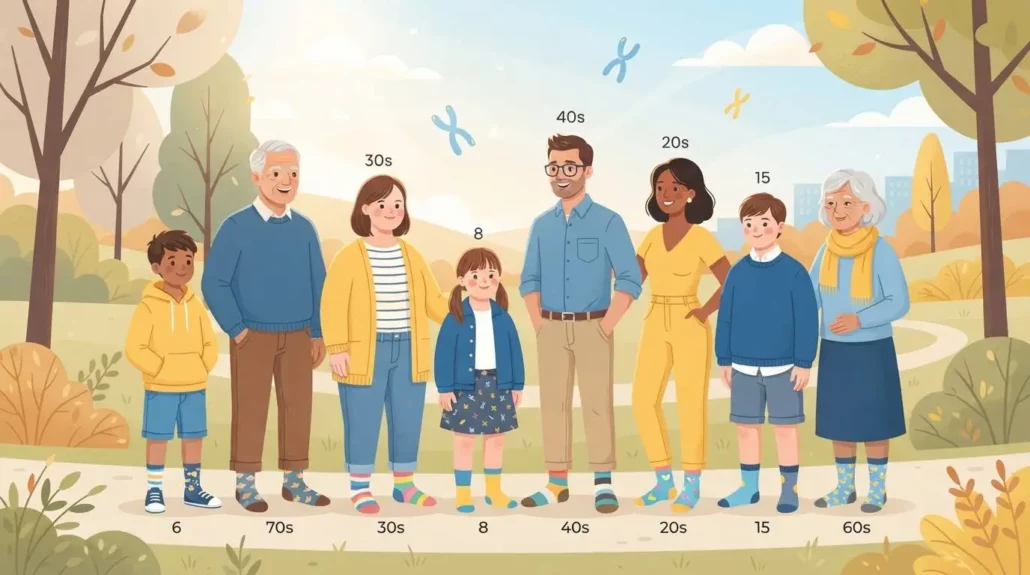
- Lots of Socks campaigns — people wear brightly colored, mismatched, or patterned socks to spark conversation about chromosome 21, since socks visually reference the shape of chromosomes.
- Awareness conferences at UN headquarters — Down Syndrome International hosts an annual World Down Syndrome Day Conference in New York, alongside related events at the UN offices in Geneva.
- School and workplace awareness events — many schools, employers, and disability advocacy groups run informal dress-up days, talks, or fundraisers rather than closing entirely.
- Social media campaigns — hashtags built around the year’s chosen theme circulate to widen public reach beyond formal events.
Because the day is an awareness observance rather than a legal holiday, participation is entirely optional for individuals, schools, and employers, and there is no uniform set of closures or entitlements attached to it anywhere in the world.
Related Observance: Down Syndrome Awareness Month
October is separately recognized in several countries as Down Syndrome Awareness Month, extending similar advocacy and education goals across a full month rather than a single date. Like March 21, this monthly observance carries no legal holiday status; it functions as an additional window for advocacy groups, schools, and employers to run campaigns, without any accompanying office or school closures.
Legal and Public Life Status
World Down Syndrome Day has no legal standing as a day off in any country. It is classified by the United Nations as an official international observance, a category distinct from a public holiday. International observances exist to draw attention to an issue and mobilize resources, not to grant time off work. Banks, post offices, courts, and public transit continue to operate on their normal schedules on March 21 in every country, regardless of how widely the day is marked locally.
Some workplaces and schools choose to run internal awareness activities on the day, such as themed dress codes or short talks from advocacy groups, but these initiatives are set at the discretion of individual organizations rather than mandated by any government. Employees planning to attend a march, conference, or advocacy event on March 21 should check with their employer directly, since no jurisdiction requires paid leave for the observance.
Frequently Asked Questions about World Down Syndrome Day
Q: Is World Down Syndrome Day a public holiday?
A: No, it is an international awareness observance, not a legal holiday. Businesses, schools, and government offices remain open as usual on March 21.
Q: Why is World Down Syndrome Day on March 21?
A: The date reflects the medical cause of the condition: trisomy of the 21st chromosome, symbolized as 3-21 (month 3, day 21).
Q: When did the United Nations first recognize World Down Syndrome Day?
A: The UN General Assembly adopted the day in a resolution passed on December 19, 2011, with observance beginning in 2012.
Q: What is the “Lots of Socks” campaign?
A: It’s a global awareness activity where people wear mismatched or colorful socks on March 21, since socks visually evoke the shape of chromosomes.
Q: How many people are affected by Down syndrome worldwide?
A: The United Nations estimates Down syndrome occurs in roughly 1 in 1,000 to 1 in 1,100 live births globally, meaning 3,000 to 5,000 children are born with it each year.
Q: Do employers have to give time off for World Down Syndrome Day?
A: No. Since it is not a statutory holiday anywhere, there is no legal requirement for paid or unpaid leave tied to the date.
Q: Is World Down Syndrome Day the same every year, or does the date change?
A: The date is fixed at March 21 every year; only the day of the week changes.
Q: Who organizes World Down Syndrome Day events?
A: Down Syndrome International coordinates global activities, working alongside national Down syndrome associations, schools, and the United Nations.
Q: Is there an official color for World Down Syndrome Day?
A: There is no single mandated color; campaigns typically encourage bright, mismatched, or patterned socks rather than one specific ribbon color.
Related Holidays & Calendars
For a full overview of upcoming dates, see the March 2027 calendar.

Chokri Hamouda runs Calendarena.com. He makes simple, printable calendar templates. His goal is to help people organize their time better. He updates the site with monthly and yearly calendars for users worldwide. Chokri focuses on making calendars that are easy to read and use. He also researches holidays and date systems to keep everything accurate.