
World Wildlife Day falls on March 3 every year. It is a United Nations international observance created in 2013 — not an official public holiday, so government offices, schools, and businesses stay open worldwide.
When Is the World Wildlife Day Anniversary? (2026–2031)
World Wildlife Day always lands on the same calendar date, March 3, regardless of the day of the week it falls on. It is not an official public holiday in any country, so no administration closes and no time off work is granted because of it.
| Date | Name | Day | Week | Days left |
|---|---|---|---|---|
| March 3, 2026 | World Wildlife Day 2026 | Tuesday | 10 | - |
| March 3, 2027 | World Wildlife Day 2027 | Wednesday | 9 | 140 |
| March 3, 2028 | World Wildlife Day 2028 | Friday | 9 | 506 |
| March 3, 2029 | World Wildlife Day 2029 | Saturday | 9 | 871 |
| March 3, 2030 | World Wildlife Day 2030 | Sunday | 9 | 1236 |
| March 3, 2031 | World Wildlife Day 2031 | Monday | 10 | 1601 |
| March 3, 2032 | World Wildlife Day 2032 | Wednesday | 10 | 1967 |
| March 3, 2033 | World Wildlife Day 2033 | Thursday | 9 | 2332 |
| March 3, 2034 | World Wildlife Day 2034 | Friday | 9 | 2697 |
| March 3, 2035 | World Wildlife Day 2035 | Saturday | 9 | 3062 |
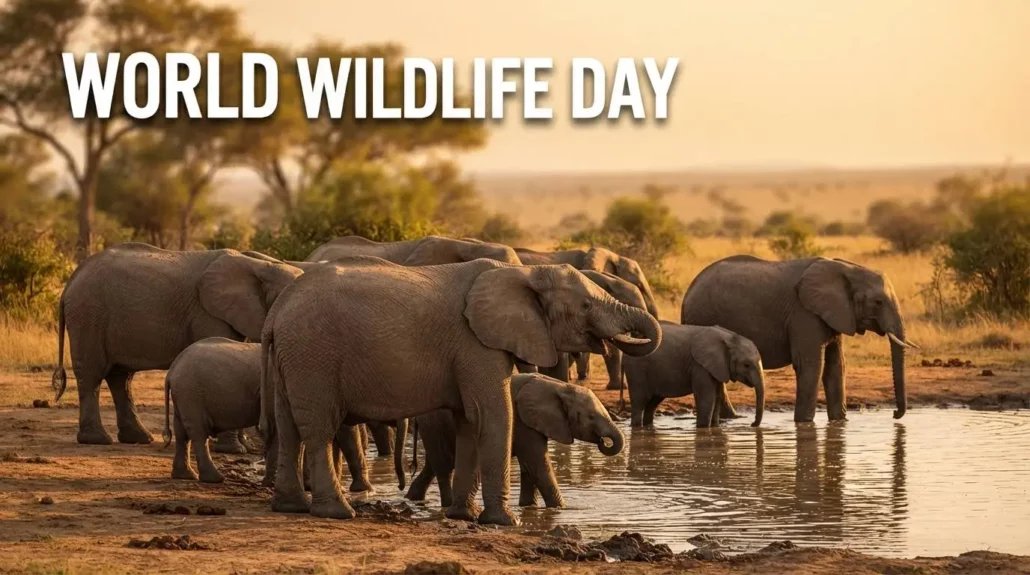
Because March 3 is a fixed date rather than a “nth weekday of the month” rule, the day of the week simply rotates forward by one (or two, after a leap year) each year — there’s no complex calculation behind it, just the standard shift of the calendar.
Origins: The CITES Treaty and the UN Proclamation
The date itself predates the observance by four decades. On March 3, 1973, representatives from dozens of countries signed the Convention on International Trade in Endangered Species of Wild Fauna and Flora, known by its acronym CITES, in Washington, D.C. The treaty was designed to make sure that international trade in wild animals and plants does not threaten their survival, by requiring permits and controls for species listed on its appendices.
CITES works through three appendices, each with a different level of protection. Appendix I covers species threatened with extinction, for which commercial international trade is essentially banned. Appendix II covers species that are not yet threatened but could become so without trade controls, so trade is allowed only with export permits. Appendix III lists species that at least one member country has asked others to help regulate. The list is reviewed and amended at the Conference of the Parties, a meeting CITES member states hold roughly every two to three years, so the exact roster of protected species shifts over time even though the treaty’s founding date never does.
Forty years later, at its 68th session on December 20, 2013, the United Nations General Assembly adopted a resolution proclaiming March 3 as World Wildlife Day, using the CITES signing date as the anchor. The proposal originated at the 16th meeting of the Conference of the Parties to CITES, held in Bangkok in March 2013, and was sponsored by Thailand, the host country of that meeting. The General Assembly asked the CITES Secretariat to facilitate the Day’s global observance in cooperation with other UN bodies, which is why CITES — rather than a separate UN office — still runs the day-to-day coordination, as confirmed on the United Nations’ own observance page.
What Happens on World Wildlife Day
World Wildlife Day is not built around a single official ceremony; instead, it is observed through a patchwork of activities organized independently by governments, conservation groups, schools, zoos, and museums around the world. Each year the CITES Secretariat announces a theme — recent editions have focused on topics such as digital innovation in conservation and partnerships for wildlife protection — and coordinates a flagship event, typically livestreamed, that brings together conservationists, government officials, and youth representatives.
Beyond the flagship event, common ways the Day is marked include classroom lessons on endangered species, social media campaigns built around the year’s official hashtag, art and photography contests aimed at young people, and public talks hosted by natural history museums and zoos. Full details on each year’s theme and partner events are published on the official World Wildlife Day site run by the CITES Secretariat. None of these activities require any legal recognition, which is part of why the Day functions purely as an awareness campaign rather than a day off.
Is World Wildlife Day a Public Holiday?
No. World Wildlife Day is a UN international observance, not a statutory public holiday in any of the 185+ countries that are party to CITES. Government offices, courts, schools, and most businesses operate on their normal schedule on March 3. The confusion is understandable, since the UN’s own materials describe it as an “international holiday” in the sense of a themed calendar occasion — but that phrasing refers to a day of recognition, not a legal day off.
Related Environmental Observances
World Wildlife Day sits within a broader calendar of UN and international environmental observances that recur every year without being public holidays. World Wetlands Day (February 2), Earth Hour (a Saturday in late March), World Water Day (March 22), and Earth Day (April 22) are among the closest in theme and timing. None of these carry statutory time off either — they function the same way World Wildlife Day does, as awareness dates rather than holidays.
Frequently Asked Questions about World Wildlife Day
Q: Is World Wildlife Day a federal or public holiday?
A: No, it is not. World Wildlife Day is a UN awareness observance, and government offices, schools, and businesses remain open on March 3 everywhere.
Q: Why was March 3 chosen for World Wildlife Day?
A: March 3 marks the 1973 signing of the CITES treaty in Washington, D.C. The UN General Assembly picked that date in 2013 to anchor the new observance to the treaty’s anniversary.
Q: What does CITES stand for?
A: CITES stands for the Convention on International Trade in Endangered Species of Wild Fauna and Flora, an international treaty regulating cross-border trade in wildlife.
Q: Does the date of World Wildlife Day ever change?
A: No. It is fixed on March 3 every year, so only the day of the week changes from one year to the next.
Q: Who organizes World Wildlife Day each year?
A: The CITES Secretariat coordinates the global observance, as requested by the UN General Assembly, working with partner UN agencies and conservation organizations.
Q: How can someone take part in World Wildlife Day?
A: Common ways include joining a local museum or school event, following the year’s official campaign on social media, or learning about the CITES-listed species most relevant to your region.
Q: When is the next World Wildlife Day?
A: The next occurrence is always the upcoming March 3 — see the table above for the exact weekday in any year through 2031.
Q: What is CITES and why is it linked to this date?
A: CITES is the international treaty regulating wildlife trade, signed on March 3, 1973. The UN chose that anniversary as the basis for World Wildlife Day forty years later.
Q: Does every country recognize World Wildlife Day the same way?
A: All UN member states are invited to observe it, but participation is voluntary and informal. There is no uniform, legally mandated way it must be marked.
Related Holidays & Calendars
For more dates from the same year, see the USA March 2027 calendar.

Chokri Hamouda runs Calendarena.com. He makes simple, printable calendar templates. His goal is to help people organize their time better. He updates the site with monthly and yearly calendars for users worldwide. Chokri focuses on making calendars that are easy to read and use. He also researches holidays and date systems to keep everything accurate.