
| Date | Name | Day | Week | Days left |
|---|---|---|---|---|
| September 16, 2026 | Mexican Independence Day 2026 | Wednesday | 38 | - |
| September 16, 2027 | Mexican Independence Day 2027 | Thursday | 37 | 337 |
| September 16, 2028 | Mexican Independence Day 2028 | Saturday | 37 | 703 |
| September 16, 2029 | Mexican Independence Day 2029 | Sunday | 37 | 1068 |
| September 16, 2030 | Mexican Independence Day 2030 | Monday | 38 | 1433 |
| September 16, 2031 | Mexican Independence Day 2031 | Tuesday | 38 | 1798 |
| September 16, 2032 | Mexican Independence Day 2032 | Thursday | 38 | 2164 |
| September 16, 2033 | Mexican Independence Day 2033 | Friday | 37 | 2529 |
| September 16, 2034 | Mexican Independence Day 2034 | Saturday | 37 | 2894 |
| September 16, 2035 | Mexican Independence Day 2035 | Sunday | 37 | 3259 |
 Mexican Independence Day 2026–2030 — Date, History & Traditions in Mexico
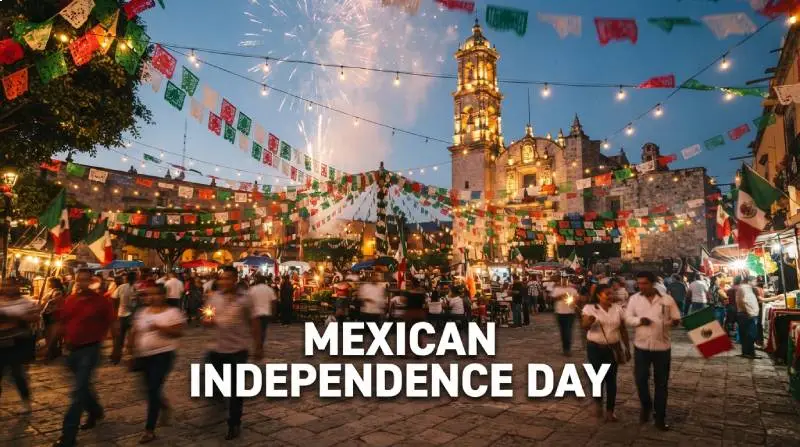 Mexican Independence Day 2026–2030 — Date, History & Traditions in Mexico
Mexican Independence Day falls on September 16 every year and is a national public holiday across Mexico. This guide covers exact dates through 2031, the history behind El Grito de Dolores, and how the country celebrates.
When Is Mexican Independence Day? (2026–2030)
Mexican Independence Day is always observed on September 16, regardless of the day of the week. It never moves to a different date, since it commemorates a fixed historical event rather than a floating observance.
Next holiday: Christmas - 25 December 2026 (72 days)
Government offices, banks, schools, and most private businesses in Mexico close on this date. When September 16 falls on a Saturday or Sunday, as it does in 2028 and 2029, the public holiday itself is not shifted to a weekday, though local celebrations often extend into the surrounding weekend.
Mexican Independence Day History & Meaning
Mexican Independence Day commemorates the start of the War of Independence from Spain. In the early hours of September 16, 1810, the priest Miguel Hidalgo y Costilla rang the bell of his parish in the town of Dolores, in what is now Dolores Hidalgo, Guanajuato, and called on the local population to rise up against colonial rule. This call to arms is known as the Grito de Dolores, or “Cry of Dolores.”
Hidalgo’s uprising was triggered ahead of schedule. The conspirators, who met regularly at the home of Josefa Ortiz de Domínguez in Querétaro, had originally planned to revolt on October 1, 1810. When an informant alerted royalist authorities to the plot on September 13, Ortiz de Domínguez managed to warn Hidalgo, forcing the insurgency to begin immediately, according to Mexico’s Secretaría de Gobernación.
The fight for independence lasted over a decade. Hidalgo was captured and executed in 1811, and other leaders, including José María Morelos y Pavón, continued the insurgent movement. Independence was not formally achieved until September 27, 1821, when the Army of the Three Guarantees entered Mexico City. Despite that later date, September 16 was adopted as the official day of celebration, marking the moment the independence movement began rather than the moment it concluded.
Every year on the night of September 15, the President of Mexico steps onto the balcony of the National Palace in Mexico City to reenact the Grito, ringing the same bell Hidalgo used and calling out the names of Mexico’s independence heroes. Mayors and governors perform the same ritual in town squares across the country at 11 p.m., followed by fireworks and the national anthem.
The green, white, and red of the Mexican flag, displayed everywhere during the holiday, carry their own symbolism: green for hope, white for unity, and red for the blood of the nation’s independence heroes. The coat of arms at the center of the flag, an eagle perched on a cactus devouring a serpent, references an Aztec founding legend and predates the independence movement itself, but it became a unifying national symbol during the fight for sovereignty.
How Mexico Celebrates Independence Day
Celebrations begin the evening of September 15, known as the Noche Mexicana or Grito night, and continue through September 16, the official public holiday.
- El Grito: Crowds gather in main plazas nationwide to hear the Grito reenactment, then respond with cheers of “¡Viva México!”
- Fireworks and music: Firework displays follow the Grito in most cities, alongside mariachi performances and traditional folk dancing.
- Decorations: Streets, homes, and public buildings are decorated in green, white, and red, the colors of the Mexican flag.
- Traditional food: Pozole, a hominy and meat stew, is a staple dish, along with chiles en nogada, tacos, and tamales.
- Military parade: On September 16, a large military parade runs through the historic center of Mexico City, reviewed by the President.
Where Independence Day Is Celebrated Beyond Mexico
Mexican communities outside Mexico also mark September 16 as a cultural celebration, though it is not a public holiday in these countries. Cities in the United States with large Mexican-American populations, including Los Angeles, Chicago, and San Antonio, host parades, festivals, and Grito events organized by consulates and community groups. Mexican consulates worldwide typically host their own Grito ceremony on the evening of September 15, allowing citizens abroad to take part in the same tradition observed in Mexico. Because the holiday is tied to a fixed civic date rather than a religious calendar, planning ahead is straightforward for organizers in any time zone.
Mexican Independence Day vs. Cinco de Mayo
Mexican Independence Day is often confused with Cinco de Mayo, but they are different holidays. Independence Day, on September 16, marks the start of the fight for freedom from Spain in 1810 and is Mexico’s most important civic holiday. Cinco de Mayo, on May 5, commemorates a single military victory over French forces at the Battle of Puebla in 1862, and it is a regional observance in Mexico rather than a national public holiday. Cinco de Mayo is celebrated more prominently in the United States than in most of Mexico.
Frequently Asked Questions about Mexican Independence Day
Q: What date is Mexican Independence Day?
A: Mexican Independence Day is always September 16. It is a fixed date and does not shift between years.
Q: Is Mexican Independence Day a public holiday?
A: Yes. It is an official national public holiday in Mexico, with government offices, schools, and banks closed.
Q: Why is the Grito celebrated on September 15 at night?
A: The original uprising began overnight on September 15–16, 1810. Officials reenact it at 11 p.m. on the 15th to match the historical timing.
Q: What is the Grito de Dolores?
A: It is Miguel Hidalgo’s 1810 call to arms against Spanish rule, reenacted every year by the President and by local officials nationwide.
Q: Is Mexican Independence Day the same as Cinco de Mayo?
A: No. Independence Day (September 16) marks the 1810 revolt against Spain, while Cinco de Mayo (May 5) marks a single 1862 battle victory.
Q: When did Mexico actually gain independence?
A: Independence was formally achieved on September 27, 1821, but September 16 is celebrated as it marks when the movement began.
Q: Do businesses close on Mexican Independence Day?
A: Most government offices, banks, and schools close. Many private businesses also close or adjust hours, especially in the evening of September 15.
Q: What colors are associated with Mexican Independence Day?
A: Green, white, and red, matching the Mexican flag. Streets, homes, and clothing are typically decorated in these colors throughout the holiday.
Q: Does Mexican Independence Day fall on the same date every year?
A: Yes. Unlike floating holidays, it is fixed on September 16 every year from 2026 through 2031 and beyond.

Chokri Hamouda runs Calendarena.com. He makes simple, printable calendar templates. His goal is to help people organize their time better. He updates the site with monthly and yearly calendars for users worldwide. Chokri focuses on making calendars that are easy to read and use. He also researches holidays and date systems to keep everything accurate.