
Daylight Saving Time Start Dates (2027–2031)
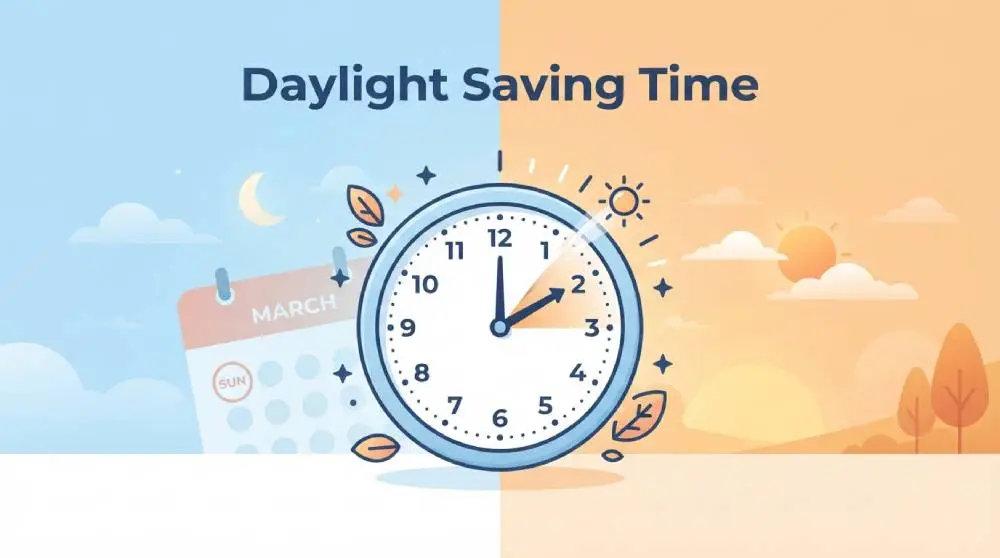
In the United States, Daylight Saving Time starts on Sunday, March 14, 2027, when clocks move forward one hour at 2:00 a.m. local time. The next start dates run through 2031, listed in full below.
| Date | Name | Day | Week | Days left |
|---|---|---|---|---|
| March 14, 2027 | Daylight Saving Time Starts 2027 | Sunday | 10 | 151 |
| March 12, 2028 | Daylight Saving Time Starts 2028 | Sunday | 10 | 515 |
| March 11, 2029 | Daylight Saving Time Starts 2029 | Sunday | 10 | 879 |
| March 10, 2030 | Daylight Saving Time Starts 2030 | Sunday | 10 | 1243 |
| March 9, 2031 | Daylight Saving Time Starts 2031 | Sunday | 10 | 1607 |
| March 14, 2032 | Daylight Saving Time Starts 2032 | Sunday | 11 | 1978 |
| March 13, 2033 | Daylight Saving Time Starts 2033 | Sunday | 10 | 2342 |
| March 12, 2034 | Daylight Saving Time Starts 2034 | Sunday | 10 | 2706 |
| March 11, 2035 | Daylight Saving Time Starts 2035 | Sunday | 10 | 3070 |
| March 9, 2036 | Daylight Saving Time Starts 2036 | Sunday | 10 | 3434 |
“Days left” is a live countdown calculated from today (last updated July 20, 2026) and shortens automatically as each date approaches.
What Is Daylight Saving Time?
Daylight Saving Time (DST) is the practice of setting clocks one hour ahead in spring, then back again in fall. The idea is to shift daylight into the evening, when most people are awake and active, rather than wasting it in the early morning. DST is not a federal public holiday — offices, schools, and banks stay open as usual. It’s simply the day the clock itself changes.
When Does Daylight Saving Time Start Each Year?
Under current federal law, Daylight Saving Time always begins on the second Sunday of March:
Each start date lands one week earlier than the previous year on average, simply because the “second Sunday” shifts depending on how the calendar falls. DST then runs until the first Sunday of November, when clocks fall back to standard time.
Which States Don’t Observe Daylight Saving Time?
Not every part of the country changes its clocks. Under the Uniform Time Act, a state can opt out of DST and stay on standard time year-round, though it cannot choose to stay on permanent DST unilaterally. Hawaii and most of Arizona (aside from the Navajo Nation) skip the clock change, along with the territories of American Samoa, Guam, the Northern Mariana Islands, Puerto Rico, and the U.S. Virgin Islands. Every other state follows the same nationwide start and end dates.
The Law Behind the Clock Change
Daylight Saving Time has been federal policy since the Uniform Time Act of 1966, which standardized clock changes across states that choose to observe it and put oversight in the hands of the U.S. Department of Transportation. The current March-to-November schedule dates back to the Energy Policy Act of 2005, which extended DST by about a month starting in 2007. The stated goal was energy savings, though the real-world effect has always been debated; what has stuck around is the extra hour of evening daylight through spring, summer, and fall. The Department of Transportation publishes the official rules and current status of Daylight Saving Time in the U.S.
How to Prepare for the Time Change
A few simple habits make the “spring forward” easier on the body clock:
- Move clocks ahead the night before, so the change is already done when you wake up.
- Shift bedtime 15–20 minutes earlier for a couple of nights leading up to the change.
- Use the changeover as a reminder to check smoke detector batteries — many households already do this every DST switch.
- Give yourself extra time the following Monday morning; the lost hour of sleep tends to hit hardest on the first workday.
Check March Calendar with holidays
Upcoming Holidays And Celebrations:
| Date | Type | Name |
|---|---|---|
| 15 October 2026 | Event | Global Handwashing Day |
| 15 October 2026 | Event | Spirit Day 2026 |
| 15 October 2026 | Event | White Cane Safety Day |
| 16 October 2026 | Event | Boss’s Day |
| 16 October 2026 | Event | World Food Day |
| 17 October 2026 | Event | International Day for the Eradication of Poverty |
| 17 October 2026 | Event | Sweetest Day 2026 |
| 17 October 2026 | National day | National Pasta Day |
| 18 October 2026 | Event | Alaska Day |
| 20 October 2026 | Event | International Sloth Day |
| 20 October 2026 | Event | Vijaya Dashami 2026 |
| 20 October 2026 | National day | National Pharmacy Technician Day 2026 |
| 21 October 2026 | Event | Back to the Future Day |
| 21 October 2026 | Event | Trafalgar Day |
| 21 October 2026 | Event | Unity Day 2026 |
| 21 October 2026 | National day | National Apple Day |
| 22 October 2026 | National day | National Color Day |
| 22 October 2026 | National day | National Nut Day |
| 23 October 2026 | National day | National Paralegal Day |
| 24 October 2026 | Event | Stock Market Crash |
FAQ
When does Daylight Saving Time start in 2027?
Daylight Saving Time starts on Sunday, March 14, 2027, at 2:00 a.m. local time, when clocks move forward one hour.
Do all U.S. states observe Daylight Saving Time?
No. Hawaii and most of Arizona stay on standard time year-round, along with several U.S. territories, while the rest of the country follows the same national start and end dates.
Why do clocks move forward in March?
The March start date comes from the Energy Policy Act of 2005, which extended Daylight Saving Time to begin on the second Sunday of March and end on the first Sunday of November.
What time does the clock change happen?
The change officially takes effect at 2:00 a.m. local time, which is why most people simply set their clocks forward before going to bed the night before.

Chokri Hamouda runs Calendarena.com. He makes simple, printable calendar templates. His goal is to help people organize their time better. He updates the site with monthly and yearly calendars for users worldwide. Chokri focuses on making calendars that are easy to read and use. He also researches holidays and date systems to keep everything accurate.