
When is Emancipation Proclamation:
| Date | Name | Day | Week | Days left |
|---|---|---|---|---|
| January 1, 2026 | Emancipation Proclamation Anniversary 2026 | Thursday | 1 | - |
| January 1, 2027 | Emancipation Proclamation Anniversary 2027 | Friday | 53 | 79 |
| January 1, 2028 | Emancipation Proclamation Anniversary 2028 | Saturday | 52 | 444 |
| January 1, 2029 | Emancipation Proclamation Anniversary 2029 | Monday | 1 | 810 |
| January 1, 2030 | Emancipation Proclamation Anniversary 2030 | Tuesday | 1 | 1175 |
| January 1, 2031 | Emancipation Proclamation Anniversary 2031 | Wednesday | 1 | 1540 |
| January 1, 2032 | Emancipation Proclamation Anniversary 2032 | Thursday | 1 | 1905 |
| January 1, 2033 | Emancipation Proclamation Anniversary 2033 | Saturday | 53 | 2271 |
| January 1, 2034 | Emancipation Proclamation Anniversary 2034 | Sunday | 52 | 2636 |
| January 1, 2035 | Emancipation Proclamation Anniversary 2035 | Monday | 1 | 3001 |
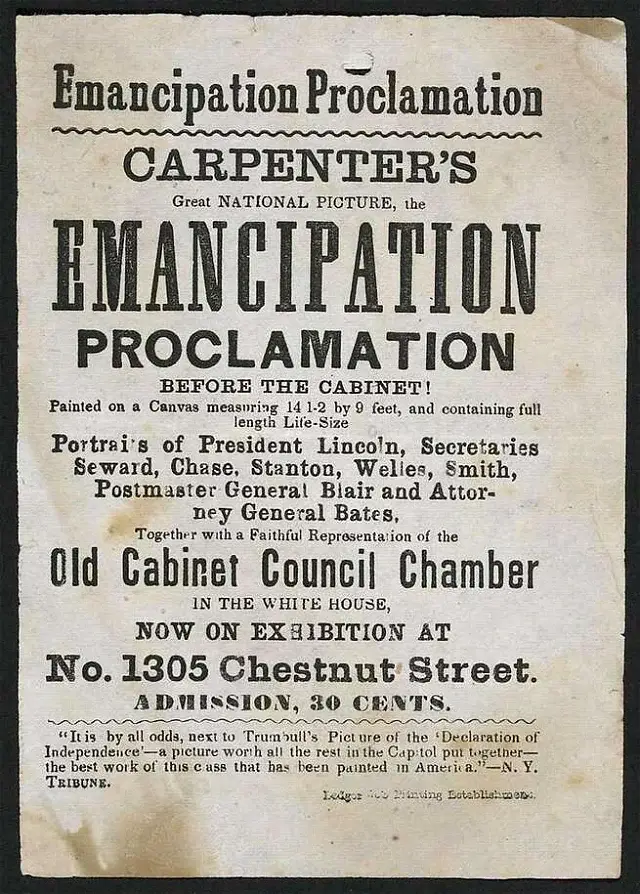
The Emancipation Proclamation anniversary falls every year on January 1 — in 2027, that’s a Friday. On January 1, 1863, President Abraham Lincoln’s executive order took full legal effect, declaring “that all persons held as slaves” within the rebellious Confederate states “are, and henceforward shall be free.” It remains one of the most consequential documents in American history, even though — as covered below — it did not immediately free every enslaved person in the country.
Key facts at a glance:
- Anniversary date: January 1 (fixed every year)
- Issued in final form: January 1, 1863
- Preliminary proclamation: September 22, 1862
- Issued by: President Abraham Lincoln
- Type: Presidential executive order, not a federal public holiday
What Did the Emancipation Proclamation Actually Do?
The Emancipation Proclamation declared free all enslaved people in states “in rebellion against the United States” — the Confederacy. It did not, however, apply to the border states that remained in the Union (such as Kentucky, Missouri, Maryland, and Delaware), nor to areas of the Confederacy already under Union control. Its practical enforcement depended entirely on the advance of Union troops, since the federal government had no way to enforce it in Confederate-held territory.
Two things it did accomplish immediately: it reframed the Civil War as a fight over slavery, not just the preservation of the Union, and it formally allowed formerly enslaved men to enlist in the Union Army and Navy — roughly 200,000 Black soldiers and sailors ultimately served.
Two Dates, One Proclamation: September 22, 1862 and January 1, 1863
There are two dates commonly confused with the Emancipation Proclamation:
- September 22, 1862 — Lincoln issued the preliminary Emancipation Proclamation days after the Union’s tactical victory at the Battle of Antietam. It warned that slaves in any state still in rebellion by January 1, 1863 would be declared free.
- January 1, 1863 — Lincoln signed the final Emancipation Proclamation, putting the declaration into legal effect. This is the date observed as its anniversary.
Is the Emancipation Proclamation the Same as Juneteenth?
No — they mark different moments, though they’re often searched together. The Emancipation Proclamation (January 1, 1863) was the legal declaration. Juneteenth (June 19, 1865) commemorates the day Union troops arrived in Galveston, Texas, and enforced that freedom there — more than two years later, since Texas was the most remote Confederate state and had seen the least Union presence. Juneteenth marks the practical end of slavery’s enforcement in the last holdout state; the Emancipation Proclamation marks the legal turning point that made it possible. For the full story of June 19, see our Juneteenth guide.
Did the Emancipation Proclamation Free All Slaves?
No — this is one of the most common misconceptions about the document. It applied only to Confederate territory in rebellion and had no legal authority over slavery in the loyal border states. Full, nationwide abolition did not happen until the Thirteenth Amendment was ratified in December 1865, after the Civil War ended.
The Original Document
The original Emancipation Proclamation is held by the National Archives in Washington, D.C., and is occasionally placed on public display around its anniversary due to its fragility. You can read the full text via the National Archives or a transcribed copy via the National Park Service.
Legacy
The Emancipation Proclamation did not end slavery outright, but it set the legal and moral framework that led to it. It shifted the purpose of the Civil War, opened the Union Army to Black soldiers, and paved the way for the Thirteenth Amendment. Its legacy continues to shape the civil rights history explored in related observances like Juneteenth, Martin Luther King Jr. Day, and Black History Month.
Related Historical Events and Observances
- Martin Luther King Jr. Day — a federal holiday honoring the civil rights leader
- Juneteenth — commemorating the end of slavery’s enforcement in Texas, June 19, 1865
- Black History Month — an annual observance celebrating African American history
- Presidents Day — recognizing the nation’s presidents
- Civil Rights Day — honoring the ongoing struggle for equality
Frequently Asked Questions About the Emancipation Proclamation
When is the Emancipation Proclamation anniversary in 2027?
The Emancipation Proclamation anniversary is observed every year on January 1. In 2027, that falls on a Friday.
What did the Emancipation Proclamation actually do?
It declared enslaved people free in Confederate states still in rebellion as of January 1, 1863. It did not apply to loyal border states and depended on Union military advances to be enforced.
Why did Lincoln issue the Emancipation Proclamation?
Lincoln issued it to reframe the Civil War around the abolition of slavery, weaken the Confederacy’s labor and economic base, and open the door to enlisting Black soldiers in the Union Army.
What is the difference between the Emancipation Proclamation and Juneteenth?
The Emancipation Proclamation (January 1, 1863) was Lincoln’s legal declaration freeing enslaved people in Confederate territory. Juneteenth (June 19, 1865) marks the day that freedom was actually enforced in Galveston, Texas — the last Confederate territory to receive the news.
Did the Emancipation Proclamation free all enslaved people?
No. It applied only to the Confederate states in rebellion, not to the border states that remained in the Union. Nationwide abolition came later, with the Thirteenth Amendment in December 1865.
What was the preliminary Emancipation Proclamation?
Issued on September 22, 1862, days after the Battle of Antietam, the preliminary proclamation warned that enslaved people in any state still in rebellion by January 1, 1863 would be declared free — setting up the final proclamation.
Where is the original Emancipation Proclamation document today?
The original document is held by the National Archives in Washington, D.C.
The Emancipation Proclamation anniversary falls on January 1 every year — January 1, 2027 is a Friday. Issued by Abraham Lincoln in 1863 after a preliminary warning following the Battle of Antietam, it reshaped the purpose of the Civil War even though it didn’t free every enslaved person outright — that distinction belongs to the Thirteenth Amendment, and the day enforcement finally reached Texas is remembered separately as Juneteenth.
For more, see the National Archives’ milestone document page and Britannica’s overview. You can also read our guide to Juneteenth or download the January 2027 calendar.

Chokri Hamouda runs Calendarena.com. He makes simple, printable calendar templates. His goal is to help people organize their time better. He updates the site with monthly and yearly calendars for users worldwide. Chokri focuses on making calendars that are easy to read and use. He also researches holidays and date systems to keep everything accurate.